Category Archives: History

Muhammad Ali / Antonio Inoki … Fifty Years Ago June 1976 / Tokyo, Japan

By Tom Donelson (BWAA) Member Boxing Writers Association of America / active contributor to dmboxing.com since 2008

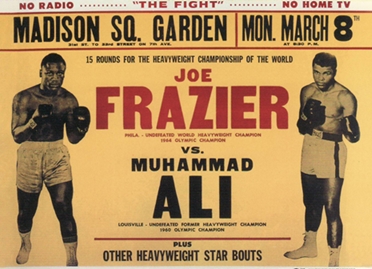
For more boxing fans, Muhammad Ali exhibition with wrestler Antonio Inoki is often a forgotten fight but this fight essentially represented a turning point in Ali’s career as the damage done to Ali’s leg hasten the end of his career.

Following the thrilla in Manila, in which Ali described as the closest to death as both Ali and Frazier beat what greatness left in their body. Ali, decide he wanted to show he was the greatest in all human combat competition and his opponent, Antonio Inoki, wanted to show his skills to a larger audience and while Japan has been the home to sumo wrestling, but professional wresting was new in Japan. And while outcomes predetermined, competitors used actual submission holds and hard strikes.

Ali was guaranteed 6.1 million to Inoki 3 million dollars, but actual rules were not decided upon at first. In 1976 and during our 200 years celebrations, America essentially forgiven Ali for Vietnam era draft battles and he was the people champion with his comeback story to win his title seven years after he was stripped of it when he knock out George Foreman in the Rumble in the Jungle. Sylvester Stallone based his antagonist in Rocky, Apollo Creed on Ali and his fight against Chuck Wepner.

There were danger signs that Ali was slowing down and the dancing master of the sixties given way to a boxer who could tolerate unearthly ability to absorb punishment. He fought Ken Norton with a broken jaw he got in the second round and still managed to survive the fight on his feet and lose a split decision. He would avenge the defeat just five months away with unanimous decision and his defeat of Foreman included Foreman pounding Ali on the ropes as part of Ali rope a dope strategy.

Continue reading Muhammad Ali / Antonio Inoki … Fifty Years Ago June 1976 / Tokyo, Japan

Richard Liborio “Richie” Guerrero

By Steve Corbo

For those following the fight game today, it is hard to believe Chicago was once one of the world’s top locations for professional boxing. No offense to my Southern California fight fans, but in the 1920’s, 30’s, 40’s, and 50’s, during boxing’s golden era, it was Chicago and New York City that were at the top of the mountain.

Both places had multiple venues running regular pro shows, often on a weekly basis. The flagship arenas being The Chicago Stadium and Madison Square Garden. If you were on a card at either, you were in the Big Leagues.

Some of the most important fights in boxing history took place in Chicago.  

In 1927 over 105,000 people packed Soldier Field, current home of the Chicago Bears, to see Dempsey- Tunney II, in what became known as “The Long Count”. With a gate of over $2,800,000 it was the first $2 Million gate, not just in boxing, but for any event! Tunney was the reigning and defending champion and received a record setting payday of $990,000 to put his title on the line against former world champion Dempsey. 

In 1937 Joe Louis beat “The Cinderella Man” Jim Braddock at Chicago’s Comiskey Park, home of the Chicago White Sox, to win the Heavyweight Championship of the World. The estimated attendance was 65,000.

In 1947, Rocky Graziano knocked out reigning Middleweight Champ Tony Zale to capture the Middleweight Championship of the World in front of a sellout crowd of 19,000 people at the Chicago Stadium. This was chapter two in their three-fight trilogy. One of the greatest in boxing history.

In 1957, Sugar Ray Roboinson stopped Gene Fullmer in the 5th round to recapture the World Middle Weight Crown at the Chicago Stadium. Before the fight, the sports books had Fullmer as a 3½-1 favorite.

Continue reading Richard Liborio “Richie” Guerrero

The Olympic Auditorium: A Look Back at a Grand Venue (Part #2 of 2)

***** FLASHBACK *****

I am delighted to bring you a feature article that was published on dmboxing.com twice (dates:   August 16, 2012 / November 16, 2014) and is one of my favorites.  It is about a historic venue that I remember growing up as a kid; I attended many boxing and wrestling matches there.  My friend Bob Quackenbush captures it all in his excellent piece.  This is part two, as part one was just posted last week for your viewing.

                          By Bob Quackenbush

www.dmboxing.com

Though boxing was the sport that put the Olympic Auditorium on the map, legions of young fans in the 1950’s, 60’s, and 70’s remember this place as the hallowed ground of Championship Wrestling.  Throughout the 1930’s, matches were held there regularly; but with the growth of television, later wrestlers such as Gorgeous George, Lou Thesz, Count Billy Varga, Freddie Blassie, the Destroyer, Mr. Moto, Mil Mascaras, Bobo Brazil, John “the Golden Greek” Tolos, Harold Sakata (who played the role of Odd Job in the movie “Goldfinger”), and Rocky Johnson (father of Duane “the Rock” Johnson) became household names.  Presided over by an actor-turned newscaster-turned sports announcer, the great Dick “Whoa Nellie” Lane, they were incredible shows in the pre-WWF days.

Around 1960, a fast-and-furious team event set up shop in the Olympic:  Roller Derby.  The L.A. Thunderbirds were the hometown favorites, with Ralphie Valladeras and his wife, Honey Sanchez, leading the way.  The venerable Lane also provided the commentary and conducted interviews for the programs which were aired locally, as were the wrestling matches, on KTLA Channel 5.

The contests at the Olympic came about through the efforts of a special group of people, the promoters.  Over the years, there were many memorable names, some better known than many of the fighters they signed.  In 1942, Cal Eaton held the job.  Working in the business office was a lady by the name of Aileen LeBell.  She and Cal married and later became co-promoters.

When Cal passed away in 1965, Aileen, known as the First Lady of Boxing, continued on as sole promoter for the next fifteen years.  Her sons from her first marriage, Mike and “Judo Gene” LeBell, also promoted various events at the Olympic.  Gene is well known to this day as a national and international judo champion, master of the art of grappling, and stunt man.  California legends George Parnassus, Don Fraser, and Don Chargin were other influential promoters at this boxing and wrestling hotbed, along with matchmakers Babe McCoy and Mickey Davies.  Other fixtures at the arena were Chief Inspector Joey Olmos of the California State Athletic Commission and publicity icon Luis Magana.

In addition to Dick Lane, there were other famous voices and visages who reported on events at the Olympic.  Well known broadcasters for boxing included  Jim Healy, Tom Harmon, and a young Dick Enberg.

Continue reading The Olympic Auditorium: A Look Back at a Grand Venue (Part #2 of 2)

The Olympic Auditorium (Part #1 of 2)

*** FLASHBACK ***

This two-part article feature was posted twice (dates: August 8, 2012 / November 8, 2014) on dmboxing.com and I am now delighted to republish it a third time. It’s wonderfully written by Bob Quackenbush regarding the historic Olympic Auditorium, Los Angeles, California. This is part one, with part two to come next week for viewing.

My Uncle Peter first started taking me at a young age in 1960 to attend wrestling and boxing at this arena, my favorite venue of all time. I saw many of the great wrestlers and boxers there, and continued attending in later years.

In boxing events at the Olympic, here are my top three fights which I viewed viewing live from ringside. I’ve also included one bout that I regret missing, one that is my biggest upset, and another that is my most surprising outcome.

#1) Mando Ramos vs. Sugar Ramos / August 6, 1970 / Mando wins by split decision – 10 rounds

#2) Bruce Curry vs. Monroe Brooks / April 7, 1978 / Bruce wins by TKO – 9th round

#3) Carlos Palomino vs. Armando Muniz / January 21, 1977 / Carlos wins by TKO – 15th round

(Missed) Alfonso Zamora vs. Alberto Sandoval / October 26, 1978 / Alfonso wins by TKO – 8th round

(Upset) Jose Luis Garcia vs. Ken Norton / July 2, 1970 / Jose wins by KO – 8th round

(Surprise) Salvador Sanchez vs. Juan Escobar / April 15, 1978 / Majority Draw – 10 rounds

Respectfully, David Martinez / Boxing Historian

Now, here is Bob’s article to enjoy. For further outstanding pieces and information about Bob, go to the category menu section and click on his name to view.

Continue reading The Olympic Auditorium (Part #1 of 2)

Carlos Chavez / Memories

By David Martinez / Boxing Historian / dmboxing.com

A fighter that my uncle admired, and one which was before my time in boxing, was Carlos Chavez.

My uncle’s favorite boxer, though, was Manuel Ortiz. He met Ortiz on several occasions when both were living in the Imperial Valley town of El Centro, California.

I recall my uncle telling me that Carlos Chavez fought all the best boxers in a career that spanned seventeen years, from 1939 to 1956.

Chavez’s opponents included Lou Salica, Harold Dade, Lauro Salas, Willie Pep, Jimmy Carter, Paddy DeMarco, Tony DeMarco, Mario Trigo, Tony Olivera, Art Aragon, Jesse Flores, Eddie Chavez, Maxie Docusen, Paulino Montes, Cisco Andrade, and his epic five-bout series with all time great, Manuel Ortiz.

Continue reading Carlos Chavez / Memories

The Airborne Champion

By Steve Corbo

The young kid pictured above lied about his age to get into the military at the end of WW II. He used the birth certificate of a friend’s cousin to fool the recruiters and at the age of 16, entered the Army under a name other than his own. Born Carmine Orlando Tilelli, he would become known to the world as Joey Giardello.

He became a paratrooper. And although he entered the service too late to see combat in WW II, he served with the elite 82nd Airborne Division. Discharged from the Army in 1948, he kept his assumed name, and this super tough 18-year-old turned pro, launching a ring career which would span 19 years.

A master boxer known for his ability to take a punch, he “fought ‘em all”, racking up wins against some of the top contenders of the day including Ralph Tiger Jones, Bobby Boyd, Al Andrews, Holly Mims, and Del Flannigan. He even beat a past-his-prime Sugar Ray Robinson in a ten-round decision.  His majority decision win over contender Henry Hank was voted by Ring Magazine as “The Fight of The Year”! In what has been described as a foul-filled street fight, he got a shot at Middleweight Champ Gene Fullmer. With the World Championship on the line, they battled for 15 rounds to a split draw. 

Finally, after toiling in the game for 15 years, he climbed to the top of the mountain beating Dick Tiger on December 07, 1963, in Atlantic City, to capture the WBC Middleweight Championship of the World.

Continue reading The Airborne Champion

Joshua vs. Paul … and some personal history of my own!

By Tom Donelson / Member Boxing Writers Association of America (BWAA)

I have a martial arts background and obtain a black belt plus orange belt in Judo (which was a requirement for a black belt as my sensi insisted his martial artist have a judo background as he noted that many fights end up on the ground.)  We had occasional kick boxing bouts in the do jo and my sensi himself fought kick boxing matches on ESPN when ESPN covered kickboxing matches in the 1980’s and early 90’s.

One weekend, I fought one of my best matches as I defeated a fellow black belt in a kick boxing matches in our dojo. My opponent was in my mid 40’s and I just turned 40. After the bout, the sensi invited me to fight some rounds with him so we went three rounds. He held back and simply wanted to get rounds in and I knew that if he wanted to send them to the canvas, he could. He connected any time he wanted and while I lasted three rounds, he allowed me to do so. I may have been wearing a black belt, but I was not a professional kickboxer and he had been one. There was a difference in skill levels between us and there was a difference between Jake Paul and Anthony Joshua.

Joshua connected 48 punches over the six rounds but 31 of them were in the fifth and sixth round. He only landed 17 over the first four rounds and it was if Joshua didn’t want to end the fight early and carried Paul for the first four rounds before letting loose in the fifth and sixth round, in which he landed the perfect one two, left jab followed by a right hand that send Paul down and broke Paul jaws.

Paul is a decent fighter who takes his craft seriously, but his victories were over fighters beyond the prime like Mike Tyson who was nearly 60 years old. Paul could beat most fighters ranked lower but against elites fighters, he is not in their class. Joshua is a former champion who was not that far beyond his prime. Paul began as youtuber and had a built-in audience when he began his boxing career and his fights brought in millions. Many fans simply watched his fight simply for his entertainment value and while many boxing purist never felt comfortable with Paul, it can’t be denied He attracted fans.

Continue reading Joshua vs. Paul … and some personal history of my own!

Jimmy Barry / The Little Tiger

*** FLASHBACK *** This article was originally published for viewing on www.dmboxing.com on August 15, 2017

By David Martinez / Boxing Historian / dmboxing.com

There is a boxer that nobody ever talks about these days. A boxer who seems to have been lost in the fog of time, but whom I rate as one of the finest to ever come out of Chicago! His name is Jimmy Barry. He was known as “Little Tiger” and this 5-feet-2 Irish kid was as good as they come.

Born on March 7, 1870 he started his professional boxing career in 1891, winning 27 straight without a loss, with 18 of those wins coming by knockout.  On December 5, 1893 he knocked out Jack Levy in 17 rounds to win the “100 pound Championship of America”.

On September 15, 1894 Barry knocked out Casper Leon in the 28th round to win the bantamweight championship. They would fight in a rematch in May 1895. The bout was ruled a draw when police stepped in to halt the bout in the middle of the 14th round. He and Leon would eventually fight each other four times, with three of the fights being a draw and the other ruled a six round no-contest decision.

On December 6, 1897, at National Sporting Club, Covent Garden, London, England Barry defeated Walter Croot in the 20th round to gain undisputed recognition as Bantamweight Champion of the World. Croot died after the fight, due to injuries he received when he was dramatically knocked out cold with a tremendous right hand to the jaw. An autopsy ruled his death resulted from being hit with such force that his skull was fractured when striking the mat.

Continue reading Jimmy Barry / The Little Tiger

Carlos Ortiz (R.I.P.)

***** FLASHBACK *****

This article was originally published on July 18, 2022 for viewing on www.dmboxing.com


David Martinez / Boxing Historian / dmboxing.com

On June 13, 2022 the boxing world lost a great champion. Carlos Ortiz passed away at the age of 85. He was born in Ponce, Puerto Rico, on September 9, 1936.

Ortiz began his outstanding professional career in 1955 with a first round knockout over Harry Bell in New York.

He suffered his first loss losing to Johnny Busso via 10 round split decision on June 27, 1958. Ortiz was 21 years old and held an undefeated ring record of 26-0 entering that bout. Three months later in September, Ortiz reversed his loss with a convincing 10 round decision win. Both Busso fights were held at Madison Square Garden, New York.

After posting a ring record of 29 wins, 2 losses, and one no-decision, Ortiz met Kenny Lane for the vacant junior welterweight / super lightweight title in New York on June 12, 1959. Lane had given Ortiz a 10 round loss prior, on December 31, 1958, but this time Ortiz would win by knockout after two rounds to become the second Puerto Rican world champion since Sixto Escobar did it more than thirty years before.

Continue reading Carlos Ortiz (R.I.P.)

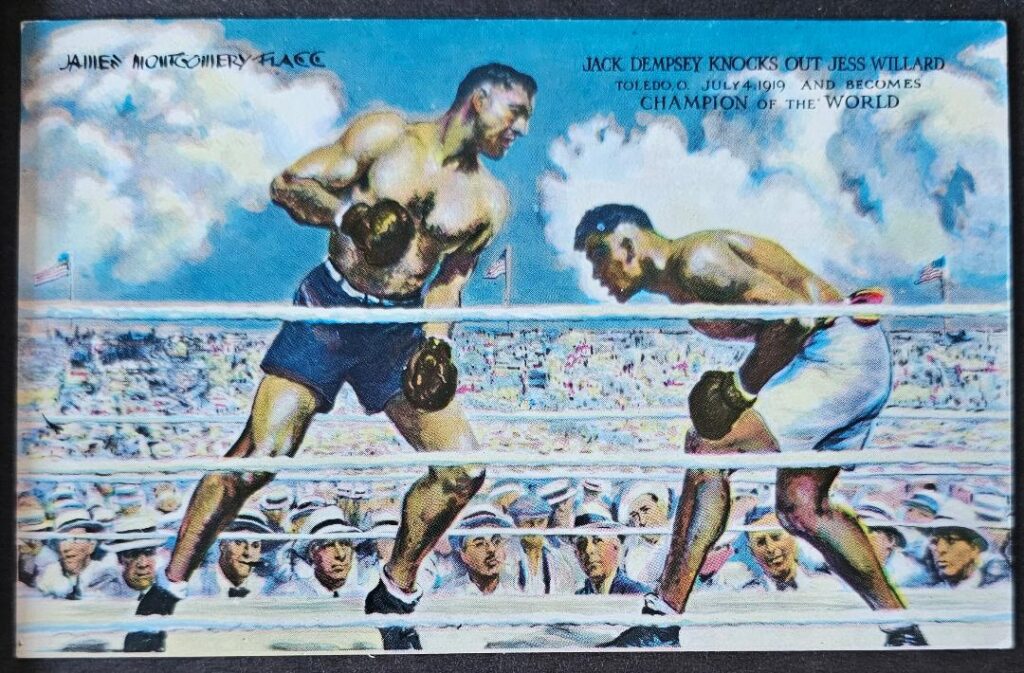
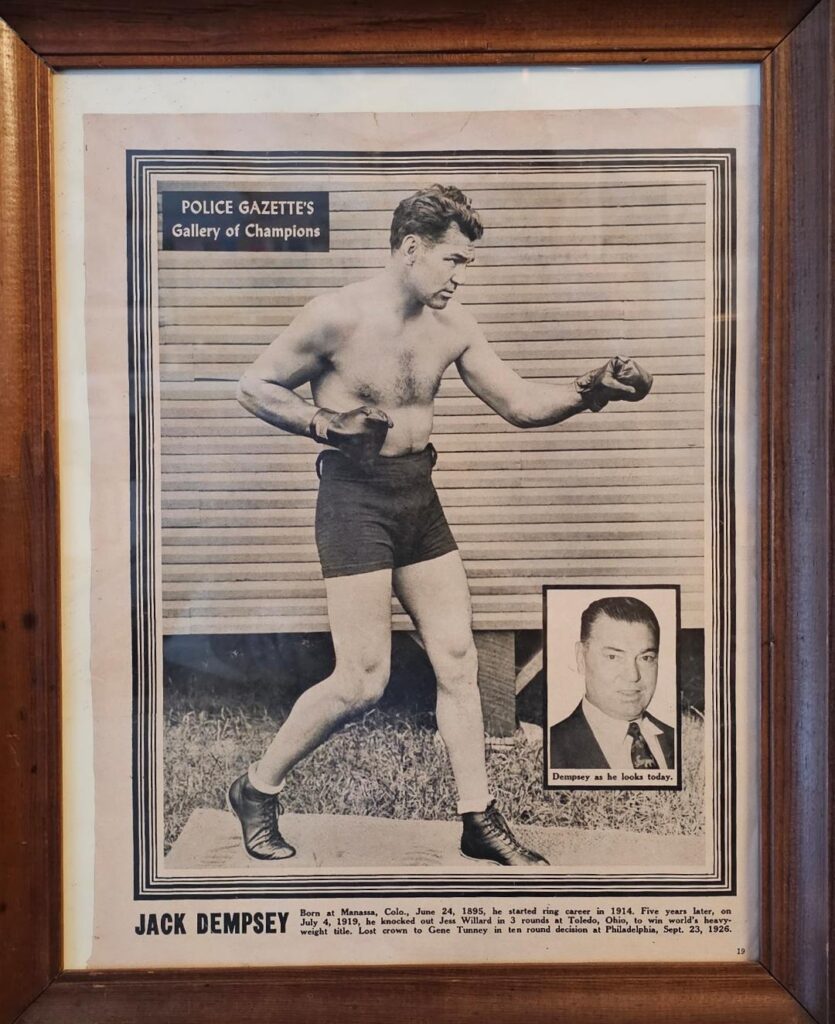
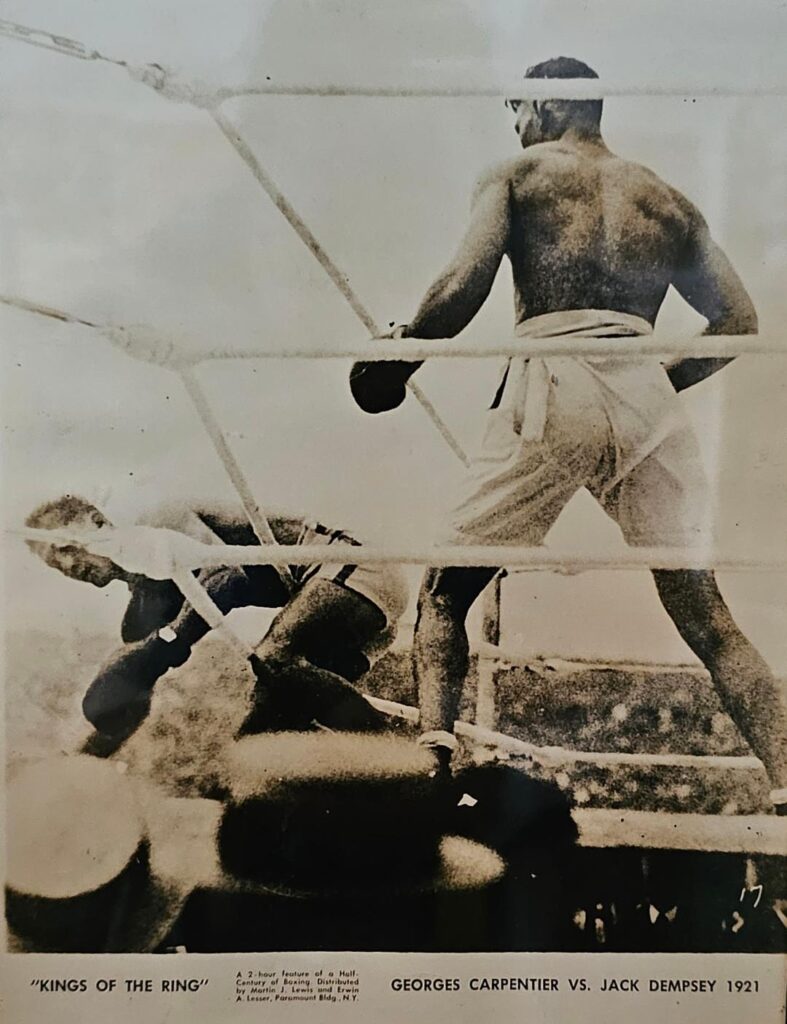
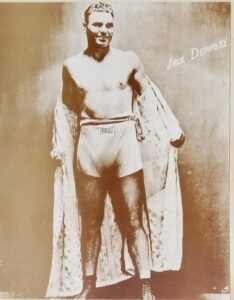
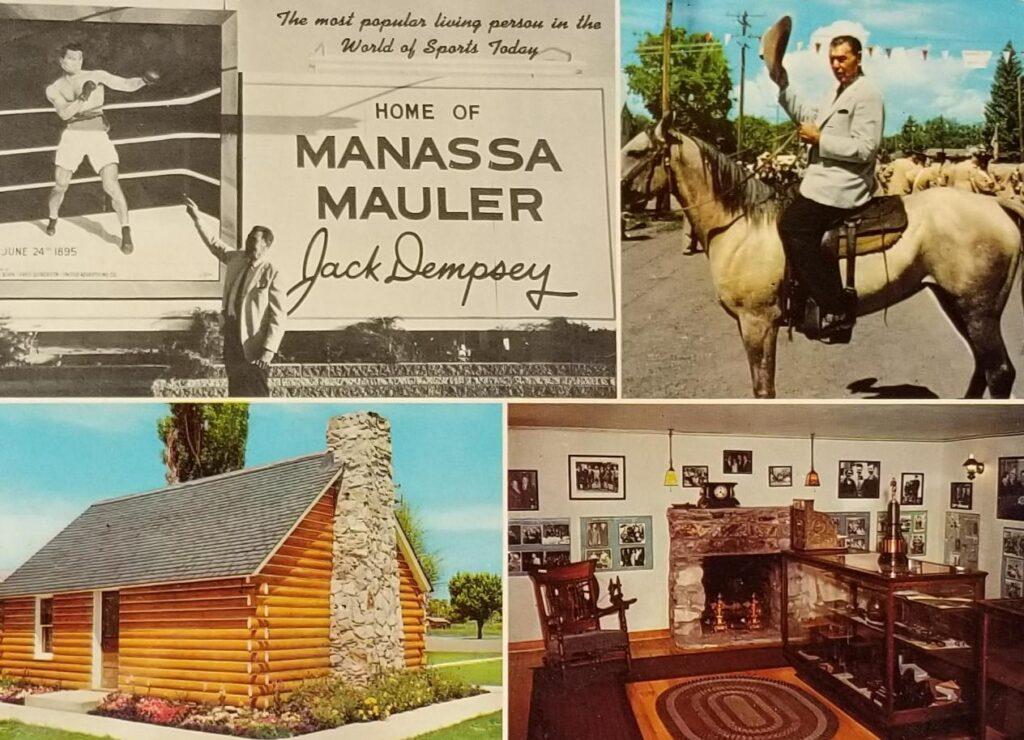
Jack Dempsey Museum, Manassa, Colorado

FLASHBACK – This article was originally published on October 9, 2023 for viewing on www.dmboxing.com

By David Martinez / Boxing Historian / dmboxing.com

It was in August 1975, when traveling back to visit my relatives in various locations in the state of New Mexico, I ventured north for an unbelievable experience, a visit the birthplace of Jack Dempsey, Manassa, which is located in the southern part of Colorado, in the “San Luis” Valley.

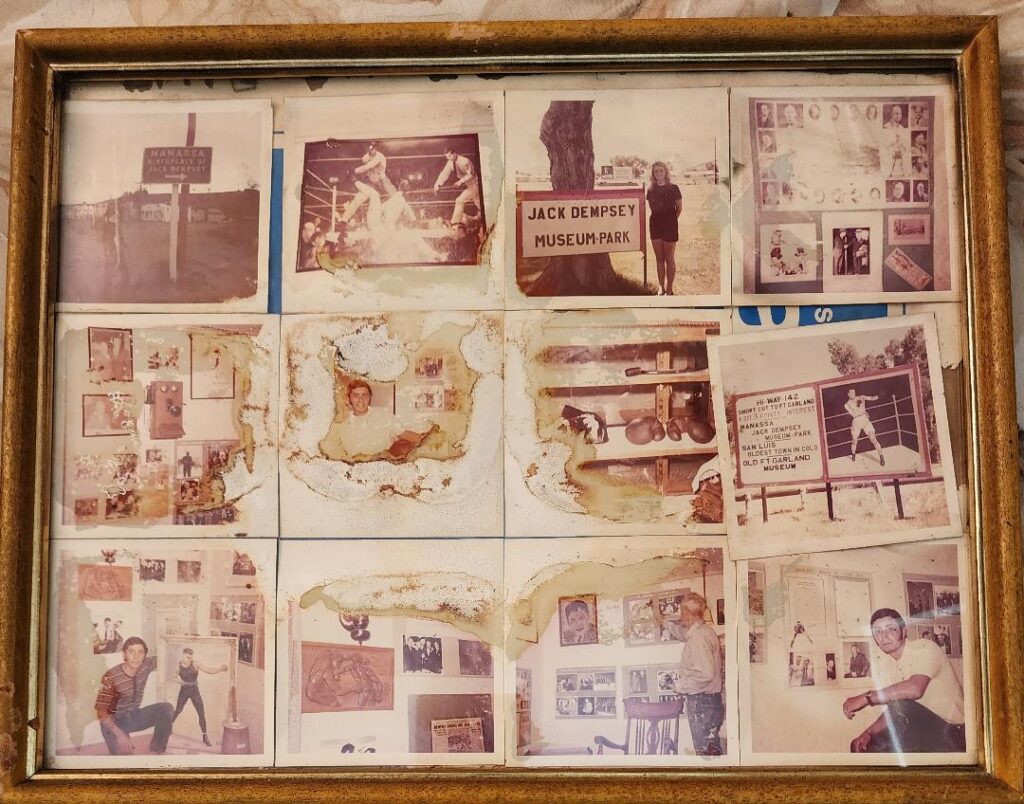
Upon my arrival, I located a log cabin style house in the middle of town, that was actually moved to this city park location in July 1966, and was refurbished in honor of Jack Dempsey. The interior walls were lined with photos and mementos of Dempsey’s brilliant career.

The Curator there was so wonderfully nice and was amazed at my focus and interest, that he thinking I lived nearby, offered me a job there as a tour guide. Then he did something that was truly amazing, removing the actual gloves from a display case that Dempsey wore in the Luis Angel Firpo fight (September 14, 1923) so I could wear them while posing for a picture.

Unfortunately, I had a misfortune happen regarding these photos. In November 1983, while moving from my old house to my new house, it started to rain that day and the water got into the U-Haul trailer we were towing and into my nicely framed photos. I cried and was so upset and disappointed beyond belief. The photo of me wearing those gloves was the one most damaged.

Continue reading Jack Dempsey Museum, Manassa, Colorado